
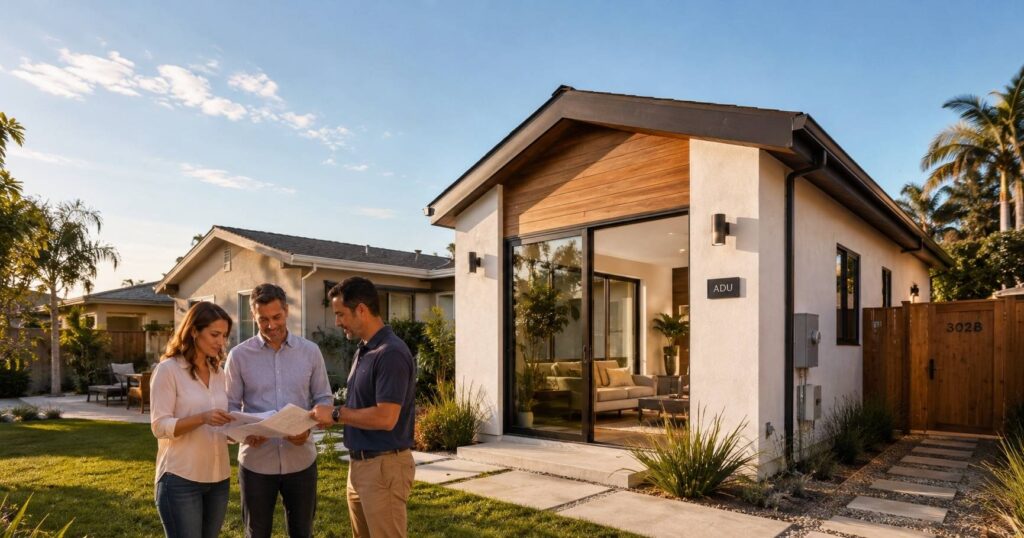
The Real Financial Math Behind Selling An ADU Separately in San Diego Under AB 1033
For years, San Diego homeowners built ADUs for one reason. Rental income.
Now the conversation is different.
Under California AB 1033, some homeowners can legally sell their ADU as a separate condo. Not rent it. Sell it. Separate title. Separate owner. Separate property taxes. Separate financing.
That changes the math completely.
A detached backyard ADU that might add $200,000 in appraised value to your property could potentially sell independently for $450,000 to $650,000 in parts of San Diego County. That gap is why people are suddenly paying attention.
But here’s the problem.
Most homeowners still think this is just an “ADU project.”
It isn’t.
The second you move into AB 1033 territory, you’re entering the world of condominium law, subdivision mapping, lender consent, HOA creation, utility restructuring, and property tax segmentation. An entirely different animal.
And yes, it gets expensive fast.
This guide breaks down the real financial questions homeowners in San Diego are asking right now about AB 1033 conversions in 2026.
What Is AB 1033?
California AB 1033 allows cities and counties to authorize the separate sale of ADUs as condominiums.
That last part matters.
Without AB 1033, your ADU stays permanently attached to your main property’s title. You can rent it. You cannot sell it independently.
With AB 1033, jurisdictions can allow condo conversions through the Subdivision Map Act and condominium mapping process.
The City of San Diego moved early and adopted its ordinance in 2025. The County of San Diego followed with Ordinance No. 10986, effective April 2026. That means places like North Park and Clairemont have had a head start, while unincorporated areas like Fallbrook, Lakeside, and Ramona are just getting started.
If you want the official county guidance, start here:
San Diego County AB 1033 Guidance PDF
And for the City of San Diego ordinance bulletin:
City of San Diego AB 1033 Bulletin
The state framework itself comes from California Government Code 65852.2.
Section 1: The Hidden Costs Nobody Mentions
This is where homeowners get blindsided.
Building the ADU is only part of the expense.
The condo conversion process is its own project.
How Much Are the Soft Costs for an AB 1033 Conversion in San Diego?
Realistically?
Most projects are landing between $50,000 and $75,000 in soft costs alone in 2026.
That number shocks people. Until they see the breakdown.
What Does an AB 1033 ADU Project Actually Cost in 2026?
This is where homeowners start doing real math.
Because once you move from “rental ADU” to “separately sellable condo,” the project changes completely.
You’re not just building square footage anymore. You’re creating a new real estate asset.
Here’s what rough 2026 budgeting looks like right now in San Diego for premium ADUs designed with future AB 1033 condo conversion potential in mind.
Unit Size | Premium Construction (Hard Costs) | AB 1033 Soft Costs & Legal | Utility Separation (Meters/Lines) | Total All-In Investment |
|---|---|---|---|---|
500 sq. ft. (1BR/1BA) | $320k – $350k | $65k | $15k – $25k | $400k – $440k |
800 sq. ft. (2BR/2BA) | $390k – $530k | $70k | $20k – $30k | $480k – $630k |
1200 sq. ft. (3BR/2BA) | $480k – $640k | $85k | $25k – $35k | $590k – $760k |
Those numbers include:
- construction
- condo mapping
- legal drafting
- surveying
- HOA setup
- utility separation work
- AB 1033 soft costs
And yes, the ranges can move depending on lot conditions, utility access, grading, fire requirements, and finish level.
But this table gives homeowners a much more realistic picture of what these projects actually look like in 2026.
Once homeowners see the full budget range, the soft-cost breakdown starts making a lot more sense.
Typical conversion costs include:
Item | Estimated Cost |
|---|---|
Tentative Parcel Map & review fees | $20k+ |
Condominium plan survey | $20k-$25k |
CC&Rs and HOA legal drafting | $7k-$15k |
HOA setup | $1k-$3k |
DRE filing coordination | $3k+ |
Utility separation work | Highly variable |
Lender/legal coordination | Variable |
The county fee schedule alone already creates a substantial baseline.
The FY 2025-2026 fee guide from County of San Diego lists:
- Tentative Parcel Map Condo Conversion: $15,530
- Parcel Map Review: $5,946
That’s over $21,000 before you’ve hired a surveyor or attorney.
Official fee guide:
San Diego County PDS Fee Schedule
And that’s why homeowners who think they’re spending “a few thousand for paperwork” get wrecked halfway through planning.
What Is a Condominium Plan?
This is the document that legally defines your ADU as a separate sellable property.
It is not a sketch.
It is a professionally prepared subdivision document that defines:
- Unit boundaries
- Airspace
- Common areas
- Easements
- Access rights
- Utility pathways
- Shared maintenance responsibilities
A licensed surveyor or civil engineer prepares it.
That survey work alone can easily exceed $20,000 in San Diego.
Why so expensive?
Because the surveyor is taking legal responsibility for a recorded subdivision map that permanently restructures property rights.
This is not “site plan drafting.”
This is title-level legal infrastructure.
The county specifically requires a condominium plan prepared by a licensed professional before approval.
Do You Need Separate Utility Meters?
Usually, yes.
This is another place where people confuse rental ADUs with condo-sale ADUs.
A rental ADU can often share utilities with the main house.
A separately sold condo unit? Different story.
Most lenders, buyers, and title companies want:
- Separate electric
- Separate water
- Separate gas
- Independent billing capability
SDG&E’s current rules generally require individually metered residential units in multi-occupancy developments.
Water is more flexible.
The City of San Diego still allows master meter structures in some condominium setups where the HOA manages allocation internally.
Official city water guidance:
City of San Diego Water Meter Standards
But practically speaking?
Separate meters make resale much cleaner.
They also reduce future HOA disputes. Which absolutely matters in a two-unit condo arrangement where both owners share one property.
Section 2: The Mortgage Problem Nobody Warns You About
This is where most projects die.
Not permitting. Not construction.
The lender.
Will Your Mortgage Company Allow You to Sell the ADU Separately?
Maybe.
Maybe not.
AB 1033 requires “Lienholder Consent.”
That means every lender with a recorded interest in your property must approve the condo split before recordation.
That includes:
- Primary mortgage lenders
- HELOC providers
- Second-position loans
And here’s the uncomfortable truth.
Many traditional lenders still have no internal workflow for AB 1033 conversions in 2026.
They weren’t built for this.
From the lender’s perspective, you’re changing the collateral securing their loan. That is a massive underwriting event.
The county itself acknowledges this issue directly in its draft guidance documents.
What Is a Partial Release of Mortgage?
In theory, the lender can release the ADU portion from the mortgage while keeping the main house secured.
This is called a partial release.
In practice?
Still uncommon in residential lending.
Most homeowners are ending up in one of three scenarios:
- Full refinance
- Collateral modification
- Payoff and replacement financing
That’s why choosing the lender upfront matters more now than ever.
Can You Build First and Condo-Convert Later?
Yes. Many people are doing exactly that.
But there is a catch.
If you’re financing construction today, you should strongly consider whether the lender has future AB 1033 flexibility already built into the loan structure.
Because refinancing later during higher-rate environments can destroy the ROI.
And rates in 2026 are not exactly cheap.
How Does This Affect Your Existing Interest Rate?
Potentially dramatically.
Imagine this scenario:
- You refinanced in 2021 at 2.9%
- You now want to condo-convert in 2026
- Your lender refuses lienholder consent
- You must refinance into a 6%+ environment
That changes the economics overnight.
Some homeowners are discovering the increased ADU resale value still makes the math work. Others realize the refinance wipes out a major portion of the benefit.
Timing matters.
Structure matters.
Lender selection matters even more.
Section 3: The ROI Math That Changed Everything
This is the section everyone cares about.
And frankly, this is why AB 1033 is exploding in interest across San Diego.
What Is the “Condo Premium”?
Here’s the simplest way to understand it.
A traditional ADU adds value to your home.
A condoized ADU becomes its own asset.
Those are completely different valuation models.
A standard ADU might add:
- $150k
- $200k
- maybe $250k
to overall appraised value.
But a separately sellable condo unit in North Park or Clairemont might independently sell for:
- $450k
- $550k
- even higher in constrained inventory markets
Why?
Because there are thousands of buyers who cannot afford a $1.1 million detached home but absolutely can afford a smaller entry-level condo.
That buyer pool is huge.
And that’s the real financial unlock behind AB 1033.
How Fast Do You Recoup the Conversion Costs?
Usually immediately.
Seriously.
Let’s use rough math:
- Conversion soft costs: $75k
- Additional utility and legal work: $25k
- Total conversion carry: $100k
If separate sale increases exit value by $300k-$500k versus a normal ADU appraisal scenario, the conversion spread massively outweighs the conversion expense.
That’s why investors are paying attention.
The separate title creates liquidity.
Liquidity creates value.
Rent the ADU or Sell It?
This is the biggest strategic decision homeowners face.
Let’s compare.
Scenario A: Rent the ADU
Monthly rent:
- $3,500/month
Annual gross:
- $42,000
10-year gross income:
- $420,000
Sounds great.
Until you subtract:
- vacancies
- repairs
- taxes
- insurance
- management
- inflation-adjusted maintenance
- tenant risk
Now compare that to immediate sale.
Scenario B: Sell the Condoized ADU
Immediate sale:
- $550,000
Potential uses:
- pay off mortgage
- eliminate consumer debt
- fund retirement
- invest elsewhere
- buy another property
That changes household balance sheets instantly.
Some homeowners prefer long-term cash flow.
Others want debt elimination immediately.
Neither is universally correct.
But homeowners should stop pretending these are equivalent strategies. They aren’t.
One is long-term yield.
The other is immediate liquidity creation.
Section 4: Property Taxes, HOA Fees, and Long-Term Carry
This is another area filled with bad information online.
Will Selling Your ADU Trigger a Reassessment of the Main House?
Generally, no.
This is one of the most misunderstood parts of AB 1033.
Under California Prop 13 rules, the original residence typically retains its existing adjusted base-year value.
Only the newly sold condo unit gets reassessed at the new sale price.
That’s because the subdivision itself is generally treated as a segregation event rather than a full taxable reassessment of the entire property.
Official California BOE guidance:
California BOE Change in Ownership Guidance
And:
California BOE Property Assessment Rules
This is a massive advantage.
If homeowners had to fully reset their original home’s property taxes every time they condoized an ADU, almost nobody would do this.
Who Pays the Property Taxes on the ADU After Sale?
The new owner.
Which means the original homeowner permanently removes:
- future taxes
- maintenance share
- insurance share
- financial responsibility
That matters more than people realize.
Especially for retirees sitting on low Prop 13 tax bases.
What Do Small ADU HOA Fees Usually Cost?
Typically:
- $150-$300/month
These HOAs are usually tiny.
Two-unit associations are common.
The fees generally cover:
- shared roof maintenance
- driveway repairs
- common insurance
- exterior obligations
- reserve funding
The CC&Rs matter enormously here.
Poorly drafted HOA documents create lawsuits later.
This is not the place to cheap out on legal drafting.
2026 Neighborhood Spotlight: City vs County
This split matters more than most homeowners realize.
The City of San Diego Moved First
Areas like:
- North Park
- Clairemont
- Normal Heights
- University Heights
already have an established AB 1033 framework under the city’s 2025 ordinance.
The city also currently imposes stronger resale marketing rules, including owner-occupant listing disclosures.
Official city ordinance materials:
The County Just Joined the Market in 2026
Areas like:
- Fallbrook
- Lakeside
- Ramona
- Valley Center
only entered the AB 1033 market in April 2026.
And the county is still actively reviewing:
- owner occupancy rules
- first right of refusal rules
- investor limitations
- attached ADU restrictions
Official county draft review materials:
San Diego County Draft ADU Ordinance Options
That means the rules are still moving.
Homeowners in unincorporated areas should pay close attention to the final 2026 revisions.
The homeowners who will benefit most from AB 1033 are not necessarily the people chasing maximum rental income.
They’re the homeowners sitting on large amounts of trapped equity who want flexibility.
Some want retirement liquidity.
Some want to help adult children buy homes.
Some want to eliminate debt without leaving San Diego.
And some simply realize a separately sellable ADU is financially worth far more than a permanently attached rental structure.
That realization is why AB 1033 matters so much in 2026.